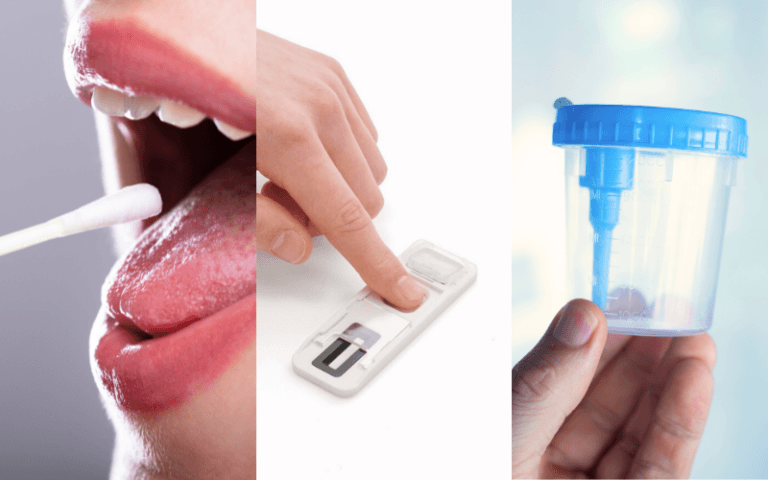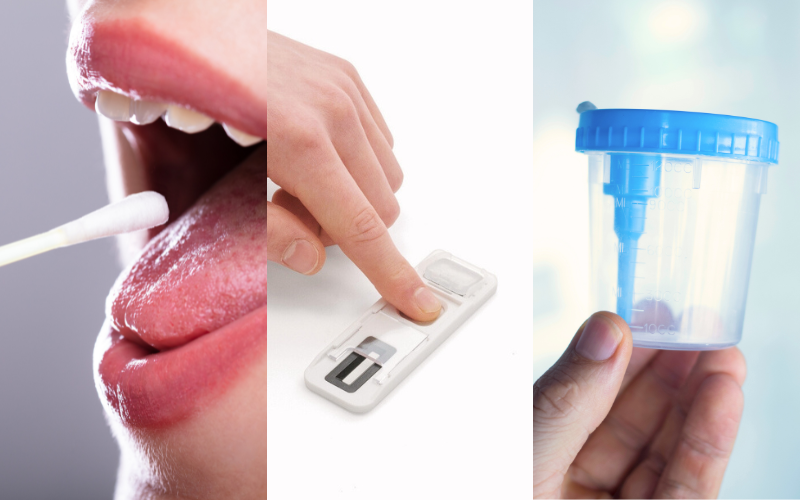
Not all drug testing methods are the same. Whether the priority is privacy, convenience, speed, or accuracy, it is important to understand the differences between the options available. This article compares the 3 most common workplace drug testing methods: fingerprint drug screening, oral fluid (saliva) testing, and urine testing. It examines each approach across the factors that matter most to employers (invasiveness, speed, hygiene, detection window, cost, and accuracy) to help organisations make an informed choice.
At a Glance: Fingerprint, Saliva and Urine Drug Testing Compared
| Criterion | Fingerprint | Saliva | Urine |
|---|---|---|---|
| Detection Window | Up to 16-24 hours | Up to 2 days | Up to 4 days |
| Average Test Time | Less than 10 minutes (2 to 3 minutes per person when batch testing) | Up to 20 minutes | 20 minutes to 4+ hours |
| Average Cost* | ~ £4,200 | ~ £5,800 | ~ £5,900 |
| Biohazard Disposal | None | Yes | Yes |
| Invasiveness | Non-invasive | Somewhat invasive | Highly invasive |
| Facilities Needed | None | None | Restroom access and gender-specific staff |
| Common Collection Issues | None | Dry mouth/nil by mouth delays | Shy bladder delays |
| Tampering Risk | None | Low | Moderate |
| Accuracy | Comparable | Comparable | Comparable |
| Sample Analysis | Unbiased digital reader | Human interpretation required | Human interpretation required |
*Based on 80 drug tests per year. Includes labour, consumables, biohazardous disposal (saliva and urine), and the cost of four non-negative results per year. Cost figures are illustrative of one modelled scenario and will vary by operation. You can model your operation’s total programme cost with the workplace drug testing cost calculator.
Non-Invasiveness and Convenience
- Fingerprint testing is entirely non-invasive. Sample collection involves simply pressing the fingertips onto a Cartridge, making it quick and easy. It can be conducted anytime and anywhere, without special facilities or gender-specific staff.
- Saliva testing is less invasive than urine testing, but it still requires a swab to be placed in the mouth. Pre-test monitoring is needed to prevent eating, drinking, or smoking for 10 minutes beforehand, which can complicate sample collection.
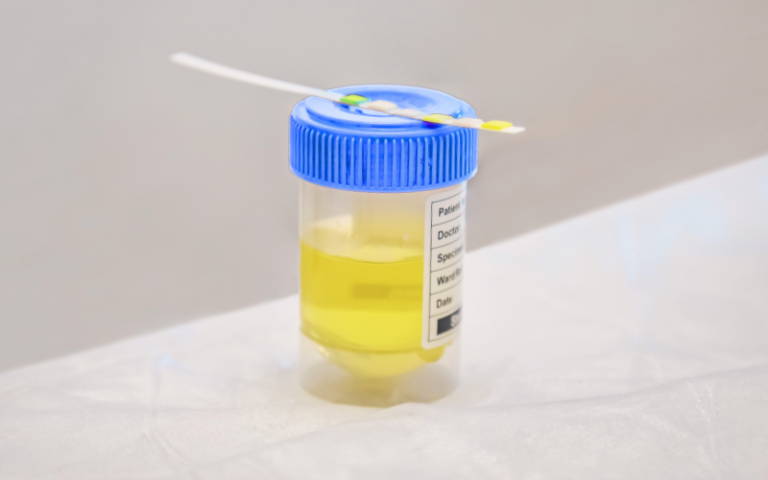
- Urine testing is the most invasive method. It often requires observation during sample collection to prevent tampering, and it typically depends on a controlled facility. A compliant urine collection setup usually includes a private restroom with restricted access, disabled water, and blue toilet dye to prevent dilution, along with temperature monitoring and secure storage before laboratory pickup. Gender-specific collectors often oversee the process. For organisations with remote teams, these requirements are difficult to meet, and employees are frequently sent to off-site testing centres, which adds travel time and cost.
Speed of Results
- Fingerprint Testing: Sample collection is completed in seconds, and results are available within 10 minutes. The quick turnaround is ideal for organisations that require immediate results.
- Saliva Testing: While generally faster than urine testing, saliva collection can be hampered by dry mouth, which is common among drug users and those on certain medications, leading to delays.
- Urine Testing: Administration-heavy. The full process, including facility preparation, collection, temperature checks, and handling any non-negative result, usually takes 20 to 30 minutes per employee, and shy bladder delays can extend it further.
Hygiene and Safety
- Fingerprint Testing: Hygienic by design, as it does not involve handling biohazardous fluids. Used cartridges can be disposed of in regular waste, with no special disposal procedures.
- Saliva Testing: Handling saliva samples can be unsanitary, with risks of leaks and spills. Biohazardous waste disposal is required, adding complexity.
- Urine Testing: Carries high hygiene risks. Spills are common, and proper disposal of biohazardous waste is mandatory.
Dignity and Comfort
- Fingerprint Testing: Discreet and preserves the dignity of the person being tested. Donors simply press all ten fingertips onto the Cartridge for a few seconds. The simplicity limits disruption and supports cooperation.
- Saliva Testing: While less intrusive than urine testing, saliva collection still involves close physical contact, which may be uncomfortable for some individuals.
- Urine Testing: Widely seen as the most intrusive and least dignified method, particularly when direct observation is required. That discomfort can reduce participation and strain trust between staff and management.
Suitability for Fitness-for-Duty Screening
The window of detection is the period during which a drug, or a metabolised by-product of a drug, remains detectable in a test sample after use. It differs markedly between the three methods:
- Fingerprint sweat: detectable for up to 16 to 24 hours from use.
- Oral fluid: up to two days from use.
- Urine: up to four days from use, and longer for habitual cannabis users.
For urine, detection times vary by substance, metabolism, and frequency of use. As a guide, cocaine is detectable for two to four days, amphetamines for one to three days, opiates for one to three days, and cannabis (THC) for up to 30 days in heavy users and usually three to seven days in occasional users.
This is where the methods diverge in purpose. When an organisation needs to support fitness-for-duty decisions, a shorter window is an advantage because it focuses on recent use and therefore more strongly suggests current impairment. A non-negative fingerprint result indicates recent drug use, which is the most relevant signal for fitness for duty. Oral fluid can return a non-negative result for someone who used drugs a day or two earlier, for example on a weekend, and who may not be impaired at the time of testing. Finally, urine detects use up to four days prior (far longer for cannabis) but is effective for identifying patterns of past use. However, urine drug tests are the least suited to answer day-of fitness-for-duty concerns.
Enhance Your Workplace Drug Testing ProgrammeContact us to schedule a demo and see how fingerprint drug testing can enhance your workplace drug testing programme. |
Cost-Effectiveness
Headline test prices tell only part of the story. The average price of a urine test is around £8, and a fingerprint Drug Screening Cartridge typically costs £17. On price alone, urine looks cheaper, but the per-test figure omits the costs that surround the test.
Urine testing adds facility setup and cleaning, staff time spent giving and collecting samples, and third-party collection or transport fees. In large or multi-site operations, these satellite costs compound quickly. Fingerprint testing removes most of them: it requires no special facility setup, no hazardous waste disposal, and collection takes under 15 minutes, with batch testing lowering the cost per test further when screening groups of people. Once you account for the full programme, the total cost of in-house testing with fingerprint screening compares favourably, as the at-a-glance figures above show. You can model your own numbers with our workplace drug testing cost calculator.
- Fingerprint Testing: Organisations can significantly reduce costs. The process requires minimal facilities and staff, reducing overall drug-testing expenses.
- Saliva Testing: While the cost of saliva test kits is similar to fingerprint Cartridges, the added logistical and disposal requirements increase the total cost.
- Urine Testing: While individual urine tests may seem inexpensive, added logistics, supervision, and dedicated facilities can make the end-to-end process more expensive.
Accuracy
No testing method delivers total accuracy, but all three produce reliable results when properly administered. Urine testing has decades of scientific validation. Fingerprint testing uses lateral flow immunoassay and fluorescence-labelled antibodies to detect specific drugs and their metabolites, and independent research shows fingerprint testing is as accurate as urine and saliva.
One practical difference is how results are read. Urine and saliva tests rely on human interpretation: a person must judge whether a faint line counts as non-negative. The fingerprint Drug Screening Reader displays a clear negative or non-negative result on screen, removing the interpretation step and the errors it can introduce.
What Happens After a Screening Result?
The screening test is only half the picture, and this principle protects every employer, no matter which method they choose. An on-site test gives a screening result, not a confirmed one. A non-negative screening result indicates possible recent drug use. It is not a positive; it should never be recorded as one, and you should not take action based on a screening result alone. Only a laboratory accredited by the United Kingdom Accreditation Service (UKAS) can confirm a screening result, using a technique such as liquid chromatography-mass spectrometry (LC-MS). This two-step approach, screening followed by laboratory confirmation, applies equally to urine, saliva, and fingerprint testing. You can read more in our explainer on what a non-negative drug test result means.
Which Method is the Right Choice?
Urine testing is the strongest choice when you need a longer detection window. This suits organisations whose policy focuses on use over several days, or where a regulated regime specifies an established evidential process. Saliva sits in the middle. It gives a more recent picture than urine, but dry mouth can delay collection, slowing the process when a donor cannot readily provide a sample. Fingerprint testing is the strongest choice when the priority is recent use and fitness for duty. This method works best when testing must run across multiple or remote sites, around varied shift patterns, when disruption must be kept to a minimum, or where dignity and acceptance matter.
When choosing a method, organisations should weigh their workforce’s specific needs and the environment where testing will take place. Fingerprint drug screening offers a non-invasive, quick, and hygienic option that fits the demands of modern workplaces, providing reliable results with minimal inconvenience and without compromising dignity or efficiency.